
At What Age Do Age Spots Start?Age spots are also referred to as liver spots in a number of cases. They are characterized by flat stature, grey, brown or black coloured growths on the skin. Age spots often appear in the shoulders, arms, face , and hands which also happen to be the areas that are mostly exposed to the sun, they are also characterized by the appearances of patches all over the exposed areas of the skin and such patches may appear very irregular in terms of shape, sizes and measurement. [continue reading…] |
At What Age Do Age Spots Start?
Pigmentation Removal: Laser Surgery
Pigmentation Removal: Laser SurgeryAmong the various treatments to get rid of age spots and pigmentation is laser surgery. Many skin doctors believe that among the several techniques to help in removing age spots & pigmentation, laser surgery is the most effective. The process is administered by guiding the laser beam to the location of the pigmentation – which then generates energy and heat, in a successive manner. Heat then targets and breaks down the skin pigmentation. However, like many other procedures, laser surgery possesses both advantages and drawbacks. Thus, select wisely by examining both these positive and negative characteristics carefully. [continue reading…] |
Diclofenac Sodium To Treat Actinic Keratosis
Diclofenac Sodium To Treat Actinic KeratosisDiclofenac can be described as a non-inflammatory, and non steroidal drug which can be used in stopping and destroying a growing lesion on the skin. This drug is often administered on a patient for a period of between 60-90 days . It is an hepatic drug with no active metabolites. Diclofenac acts in so many ways to treat actinic keratosis and such include; anti-inflammatory and analgesic {it relieves pains associated with arthritis and some skin infection treatments}. [continue reading…] |
How To Remove Pigmentation Using Manuca Honey
How To Remove Pigmentation Using Manuca HoneyHoney is known for its therapeutic, anti microbial remedial properties. For these reasons it is a common home remedy. One of the reasons why Manuca Honey is being used for pigmentation treatment is that it helps to ease off inflammation and it contains anti-microbial properties. You need to understand that ordinary honey will not have effect on dealing with pigmentation because such do not contain antibacterial components. One of the rare types of honey you can find around is the manuca honey which is produced by bees that get their nectar from the manuca forest in New Zealand. [continue reading…] |
Liver Spots Are Not Hereditary
Liver Spots Are Not HereditarySome people think that liver spots, also called age spots or sun spots, are hereditary. These people must be looking at data that show that cholesterol levels in a family are hereditary because this is a true statement. If your folks have high cholesterol then chances are good that your cholesterol will be high, also, and it may even mean that you take medication for it. Liver spots, on the other hand, are due primarily to your exposure to the sun and very little more. In other words, if you spent a lot of time in the sun when you were a child – in the pre-sunscreen era, for example — then the chances are very good that you will find your self with clusters of age spots or sunspots (other names for liver spots) all over your body. [continue reading…] |
Liver Spots May Be Unsightly But They Are Harmless
Liver Spots May Be Unsightly But They Are HarmlessCall them liver spots, age spots or their proper name solar lentigines, the only difference is what we call sun spots, those small brown dots that seem to appear one day on the back of your hand or neck or on your face, just when you don’t want them to. Are they cancerous or precancerous, only as visit to your doctor or a dermatologist will give you this information. Still, there are ways you can tell if the brown spot you are looking at is a liver spot. First, look at it closely and see if it is smooth with well-defined, rounded edges. If it is, then the chances are good that all you are seeing is an age spot. [continue reading…] |
Liver Spots: Causes & Treatment
Liver Spots: Causes & TreatmentThe ozone layer is our natural shield as it filters dangerous rays from the sun and allows only a small amount to penetrate and get into the earth’s atmosphere. Thanks to our negligence, part of the ozone layer is now eroded and most if not all the UV rays can enter the atmosphere. Needless to say there will be rising cases of people with skin conditions. One of these skin conditions is liver spots, also called age spots or sun spots. [continue reading…] |
Age Spot Treatment: Chemical Peel
Age Spot Treatment: Chemical PeelAlthough the chemical peel treatment sounds like something that should be reserved only for serious cases of skin disease that are too far gone for any other treatment, nothing could be further from the truth. A chemical peel is just another Age Spot treatment that helps alleviate a skin problem that begins right around age 40 and continues on with what seems increasing frequency over the next few years. Actually, an age spot – also known as a liver spot or sun spot – are small patches of skin pigmentation that have gone a little wild as they sit there under your epidermis. Made of the body’s skin pigment coloration agent melanin, sometimes an age spot can form for no other reason that you have been out in the sun too long and the pigment has decided to darken in response (remember the great tans as a kid? Blame your melanin!) As you age, these small patches of pigmentation move around as they please and they can become real issues especially if you are up for a job and you suddenly find that your hands look old or that your faces has dots that you don’t remember there as recently as last week. That’s the funny thing about melanin, it’s like a free radical, and it can go anywhere it wants between the upper layers of your skin and set up shop and make you look older than you are. If you look into say cryosurgery (laser removal) and find that it is too expensive for your wallet, then the chemical peel, where a special application of chemicals is placed on the surface of your skin to remove the upper layers, revealing the youthful, clear layers below is the route you should take, doctors recommend. It may take several treatments, but when you are finished you will have younger-looking, smoother skin and you will probably peeled at least half-a-dozen years off your skin’s look. Remember that sun spots or age spots are the result of exposure to ultraviolet or solar radiation so that the more time you spend out of doors the more you are likely to have age spots. It is not a condition you have to live with, though, as modern medicine has found ways to work with your skin (laser, chemical peels or dermoplasty and the like) to reverse the effects of age spots and to help make your skin younger and smoother. As with any medical process, you should expect some redness and possible soreness in the areas that are worked on but remember, too, that the advantages of this far outweigh the small downside costs you may have to pay, especially when you get the promotion you deserve and that 20-somehing who does not have your experience just has to wait. It’s a great feeling, isn’t it?
|
 Read More Articles on:
 Actinic Keratosis – Is It Something To Worry About?
Actinic Keratosis – Is It Something To Worry About?Actinic Keratosis is also known as solar keratosis and is usually a condition that one suffers by getting too overexposed to the harmful ultraviolet radiation of the sun. Its characteristics are dry skin that occurs or forms in patches that are not uniform, with these areas being either colored or discolored and such areas can further become solid like warts or growths with horn like structures. [continue reading…] |
About Age Spots
About Age Spots
Age spots characteristically build up in people with a fair complexion. However, there are also incidents of age spots in those with darker skin. To be able to determine age spots from other skin conditions, one should know how age spots look like. Age spots are flat, oval areas of noticeably greater than before pigmentation. Age spots are typically brown, black, or gray. They crop up on skin that has had the most sun exposure over time, such as the shoulders and upper back, backs of hands, tops of feet, face, etc. Age spots measure from freckle-size to more than a centimeter in diameter and can group together, making them more noticeable and obvious. Frequently, sun spots can go along with other signs of sun damage. These include deep wrinkles; dry and rough skin; fine red veins on cheeks, nose, and ears; and, skin that is thinner and more translucent-looking. Age spots are generally risk-free; hence do not require medical attention. Nevertheless, you may still seek doctor’s advice because you may not like how age spots make your skin unsightly. Moreover, spots that are dark or have changed appearance should be evaluated because these can be signs of skin cancer. Consulting a professional is advisable if a person notices skin irregularities. A dermatologist can confirm if a mark on the skin is an age spot, or if the spot is a more severe mark. A medical professional may carry out a biopsy of an age spot to eradicate the possibility of cancer. A biopsy is a procedure that involves the removal and testing of a small piece of the skin where the age spot has developed.
|
 Age spots can be visible as marks on the skin surface that are black, brown, or gray in color. Age spots can vary from the size of a freckle to larger than a centimeter across. Age spots may be visible either in a cluster or alone. Age spots are also called liver spots, and more technically, solar lentigines or sun spots. As this last term denotes, sun spots are usually caused by exposure to the damaging radiation of sun. Hence, sun spots generally can be seen on areas of the body that have received lengthened exposure to the sun, such as the arms, hands, face, and shoulders. Liver spots are most common to occur in people ages 40 and over. However, the possibility of liver spots to occur in younger people is also there depending on the amount of sun exposure received over a period of time.
 Read More Articles on:
 -
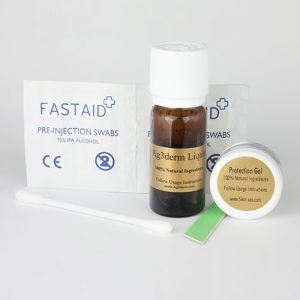 Ag3derm Pigmentation Kit
$39.99
Ag3derm Pigmentation Kit
$39.99